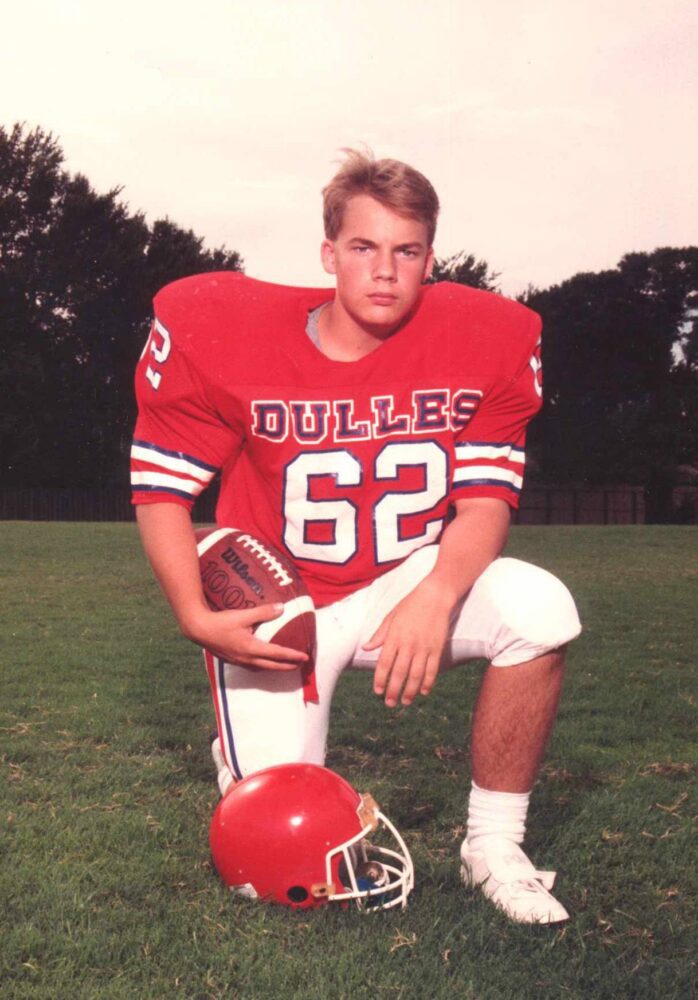
In loving memory of
Andrew Stafford
My son Andrew’s story is one of tragedy, but also one of triumph. It started early one afternoon in July 1991 when the telephone rang. A sheriff’s deputy said that Andrew, our fifteen year-old son, had been taken unconscious from a car and paramedics were driving him to a local Houston hospital.
I assumed Andrew had been in a car wreck. As a minister, I have been with many families who have received similar calls. While the anxiety is always great, I knew that many times the outcome was better than feared. I also knew that sometimes, despite the best medical attention, a child dies. I was not prepared for the story that unfolded in the next 90 minutes.
Andrew and his football teammates were attending summer school that year, so that they would have increased time to devote to football the coming autumn. Andrew had been riding home from summer school with two of his friends. Sitting in the back seat alone, Andrew was playing an air‑guitar accompaniment to one of their favorite songs on the radio. Without any signs of distress, he slumped unconscious. Ahead, a local policeman was issuing a traffic ticket to a motorist. The boys had the presence of mind to drive straight to the police car with its flashing lights. Yelling that their friend had had some kind of “seizure” they pulled Andrew from the car and the policeman radioed for EMT’s.
Coincidentally, two off‑duty paramedics were visiting a few houses away. Seeing the excitement, they identified themselves and started CPR. They later said Andrew never regained consciousness. They continued to work with Andrew until the ambulance arrived. The boys called their parents; the sheriff called me.
I walked into the emergency room where I had met so many other families. This time it was my son. When I saw one of Andrew’s friends who had been in the car, I was encouraged. If he had not been hurt then perhaps Andrew wasn’t too badly hurt. I walked back to the nurses’ station to identify myself. I wanted to see Andrew.
The head nurse told me that they were working very hard to stabilize Andrew’s heart rhythm, but were having difficulty. Moments later the cardiologist came out to tell me that things “were not going well.” They worked until mid-afternoon. I did not get to see Andrew. Finally, the cardiologist emerged grim‑faced and teary‑eyed to tell me that Andrew had died. He was a big, healthy, growing, almost 16‑year‑old. And he had died.
By now, the waiting room was filled. Hospital security guards tried to manage teenagers, their families, neighbors, church members, and others. Andrew’s older sister Katy had been summoned from her summer job at day camp; his younger brother Doug was fetched from a friend’s house. The three of us, with a minister friend, prayed in a small, family conference room. We were together when the doctor told us of Andrew’s death. The numbness, shock, and grief set in.
The weeks that followed brought new revelations. The autopsy performed by the county was unsatisfactory. A Pediatric Pathologist at Texas Children’s Hospital did a further study of Andrew’s heart. While her work yielded no specific cause of death, she and others encouraged us to have our other two children tested. Katy returned from Baylor for Labor Day weekend, just six‑weeks after Andrew’s death. After thorough testing, there it was: Long Q.T. Syndrome. Doug was tested at the outpatient clinic the next day and found to have the same thing. Both were put on beta‑blockers immediately. My EKG, done that Sunday, determined that I was the carrier. When we checked my father’s EKG, we found that he had carried it, too.
The first and most helpful information we received was from SADS. I attended SADS’ meetings, met other SADS families, and put my many questions to Long QT experts. I volunteer with SADS where I now live in Phoenix. It’s so important to raise awareness about heart conditions like Long QT in the medical and paramedical community, and for school nurses to follow-up fainting episodes with screening.
Doug continues to take the medication, and received a pacemaker several years ago. He graduated last spring from Baylor. Katy did not tolerate the beta‑blocker well and received an ICD in 1991. She’s married now, and adopted my delightful granddaughter, Abigail, four years ago. She works as a surgical nurse at Texas Children’s Hospital.
Though there are not words adequate to describe the death of a son and brother, we are grateful that through Andrew’s death we were able to have a treatable diagnosis for Katy and Doug.
Thank you for supporting SADS,
Dick Stafford