
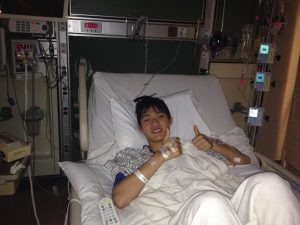
 At 18, Kory was a high school graduate with no symptoms, no warning signs, and no reason to suspect anything was wrong with his heart. He’d just had his wisdom teeth removed and was getting ready for a camping trip with his family. The recovery was rough, but nothing felt out of the ordinary.
Then, the night after they left for their trip, everything changed. “In the middle of the night, he woke up suddenly, feeling hot and awful,” Kory says. “Something was going on, I could just tell.” His family was at a campground, and assumed he was reacting badly to the aftereffects of his dental procedure. They went outside for some fresh air. When Kory returned to the camper, he had a seizure. Kory remembers coming back into consciousness and hearing his dad, who was on the phone with 911. Because they were so far from town, they made the decision to drive to the hospital themselves. It would be faster than waiting for an ambulance. “I couldn’t walk well. I felt really sick as we went in,” says Kory. What unfolded over the next several hours would shape the next decade of Kory’s life. He went into cardiac arrest six times. The medical team used paddles to bring him back, again and again. “It was scary, even though I was in and out of consciousness and not entirely sure what was happening,” Kory says. It was a lot to take in.”
Kory was unconscious for about a day. Initially the doctors thought he had Brugada Syndrome, but later found he had an extremely rare condition called J-Wave Syndrome, an inherited arrhythmia that had been silently waiting for the right combination of triggers. The general anesthesia from his wisdom teeth surgery and the dehydration and skipped meals from recovery, as Kory puts it, “woke the beast.” The decision from his medical team came quickly: Kory needed an implantable cardioverter defibrillator (ICD). “I’d never been through surgery before. It was very scary. I wasn’t sure how to process it.”
The doctor who performed his ICD implant had consulted Dr. Michael Ackerman, the SADS Foundation’s President and a global leader in inherited arrhythmia research. That connection eventually brought Kory into Dr. Ackerman’s care, where he remains today. “He wants me to just live my life and be a normal adult,” Kory says of Dr. Ackerman. “I have some restrictions, but otherwise my instructions are to live a normal, full life.”
A Diagnosis That Brought Challenges
In the years following his diagnosis, Kory weathered atrial flutter, atrial fibrillation, and recurring episodes of ventricular fibrillation. He later trialed Quindine, but had an adverse reaction to it. He underwent an ablation to help address these

 ongoing issues with his heart rhythms in March 2018, and a second ablation that October. His care team started flecainide therapy, and over the next several years, his ICD delivered shock after shock – sometimes clustered within days of each other. “I’ve been shocked 29 times,” Kory says.
The turning point came in February 2022, when Dr. Ackerman added an experimental herbal supplement called Acacetin to Kory’s flecainide regimen, combined with pacing through his ICD. Prior to this, Dr. Ackerman and his research team tested Acacetin on Kory’s stem cells and it appeared to be a successful treatment for J-Wave Syndrome. A research article regarding Kory’s condition and the use of his acacetin with his stem cells was published in the fall of 2022. This new protocol changed the trajectory of his care. Aside from a single appropriate ICD shock in January 2023, Kory has now gone more than three years without an event.
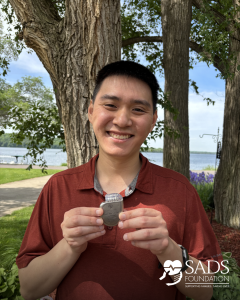
In February 2025, Kory’s ICD battery needed to be replaced. He’d been bracing for it. “I had a supportive system to help me through everything, and it ended up being an easy replacement. I was discharged the same day.” The device manufacturer allowed Kory to keep his first ICD as a memento. “I have it on hand to remind me that it kept me alive for nine years,” he says. “It came with a lot of memories, both good and bad.”
Finding His Community
For years after his diagnosis, Kory didn’t know anyone else his age living with an ICD. “It was hard for friends to relate or be supportive,” he says, “even though they really wanted to be – just because it’s a unique experience to be my age and have a heart condition.”
 That changed when he connected with Genevie Echols, the SADS Foundation’s Director of Family Support and Research, and joined the ICD Support Group. Now, he’s a regular voice in the monthly meetings and serves on the Brugada Syndrome Steering Committee. “I like to vouch for other young adults,” he says. “I don’t want them to feel like there’s no hope or support or resources. Being a voice – this is what I want to see in the future of the Foundation and for my condition. I love our group and helping others.”
Advice for the Newly Diagnosed
For those dealing with a new diagnosis of inherited arrhythmias – especially other young adults – Kory’s advice is to seek support and ask questions. “At first, I felt like I didn’t need help, or that nobody would care. Don’t let that negative voice dictate whether you reach out for support.
Being curious and knowing about your condition is so important. The SADS Foundation has been great for making sure everyone stays informed and comfortable. They’re here to help however you need.”